Friday, April 17, 2015

Depression in Graduate School

If anecdotal evidence is anything to go by, there seems to be a strong co-relation between depression and graduate school. Just in the last year or so, I have known of at least 4 grad students who have been clinically diagnosed with depression and have had to either quit grad school or take a break from their research to undergo treatment. I got to know of the most recent one earlier this week, and this is what has inspired me to put my thoughts into words.

A vast majority of grad students at some point or the other would be frustrated by the progress of their projects. Therefore, given that stress is major trigger for depression, it doesn't seem too out-worldly to hypothesize that a significant number or graduate students could be depressed. I tried searching for any studies on this. I found a couple of relatively recent news articles on nature and science that addressed this. The articles quoted from multiple studies that weren't always consistent in terms of relative percentages. But both these articles seemed to agree that there definitely was a sizable number of grad students who had depression or anxiety related problems. Another constant theme was that the resources available to the students to overcome these issues was limited at best. 

Even when resources exist I have noticed that it is not willingly taken advantage of. One of the reasons is that stigma associated with mental illness is still pretty real. A lot of grad students are from countries where this stigma is even more acute. The story of the person of whom I heard earlier this week exemplifies this best. She is an Indian girl, who after completing work on her thesis at a foreign university, had an extremely tough time job hunting. This stress led to a breakdown and she was admitted to a hospital for a few days. Her parents came over from India and took her back home. Instead of continuing treatment in India, they chose to hide the problem as they were afraid of the stigma associated with depression. This was not limited to the parents alone. If anything, the denial of the issue coming from her sister seemed to be stronger. While all this was happening, from a neutral observer's perspective her condition only seems to be getting worse. She started posting extremely random and incoherent things on her facebook wall. I hadn't spoken to her personally in over seven years. Even at that time I was, at best, an acquaintance. Yet a couple of days ago she sent me these extremely random messages via chat that didn't make much sense. When I say the messages didn't make sense, they were not random letters typed out on a keyboard. They seemed to be something that she was definitely trying to communicate but written by someone who was extremely confused or disturbed. I spoke to her her friends after I got these messages and they gave me all the background information. The most saddening part of this is that the family is more concerned about the difficulties in getting her married if the news of her condition spreads rather than helping her fix the problems affecting her. 

Another thing of note is that of the 4 people that I knew who were diagnosed with depression 3 were people from India. Yes a decent number of my friends are immigrant graduate students, and that does bias the data. Making conclusions based on a small sample size is by itself cringe worthy. When you add the poor quality of this dataset it is completely abhorrent.  But, I do believe the circumstances of being a foreigner do contribute to this problem. The access to a support system is limited. Your family and close friends are halfway around the earth. Not finding a job when you graduate would mean you have to forcefully go back to your home country. The opportunities available in your home country may not match up to your dreams and ambitions. All these can definitely be genuinely stressful. A systematic study to understand the effect of these stresses on immigrant grad students would really be useful. Besides these stresses, therapists probably find it difficult to understand the problems faced by immigrants. Maybe, it was just a case of a bad counselor, but one of my friends was essentially shooed away by a therapist saying that there was nothing wrong with her. She went through a couple of years of insomnia and anxiety before she was able to push herself to see a different counselor who helped her get back on track. 

I tried looking up resources provided to deal with depression and anxiety by the international centers at the two universities that I am associated with. I could not easily find anything significant on the website of the University of Illinois. At UCSD there was a link to the counselling services center where they seemed to underline the fact that provide culture specific services. 

People who are suffering with depression are also usually very reluctant to take help. The first response is almost always denial. At this stage it would really help if there were strong peer networks where they can candidly talk about their issues. A group of students at UC Berkley did set something like this up. The fact of the matter is you don't have to be suffering from crippling problem before you seek help. Either from peers or from professionals. For the last few years I have been posting very rarely on my blog. But if any of my friends at UCSD reads this and would like to help me set up a peer network here please let me know. If there are groups that already do this, please let me know as well. I would be talking in person to a few more friends and the Counselling center and hopefully get the ball rolling on this soon.


Monday, October 6, 2014

To be or not to be (with India)

Haider is the first Hindi movie that tells the story of life during the worst phase of militancy in Kashmir and the equally strong response of the Indian army. The fact that Vishal Bharadwaj adapts Hamlet to tell this story is a testament to his skill. Every aspect of Hamlet from his quest of revenge, his stress induced insanity, the sexual tension with his mother was present in the movie. But what I loved the most about this movie was that the point of view of Kashmiri separatists was not mellowed down. In fact, it was so in you face, that I am surprised the sanghis and their goons haven't gone about doing their usual drill of throwing black ink at Vishal Bharadwaj's face or demanding that the movie be banned.

I have always held a view that people should have the right to determine their destiny and nothing should be forced upon them. I have never articulated this in the Kashmiri context and this is a nice opportunity to do so.

Living in constant fear is one of the worst ways to live. And for those ten odd years the Kashmiris lived extremely horrible lives. On the one side the militants were going about terrorizing people and to compete with them the Indian state basically laid siege on the entire state. Random ID checks, restricted movement, nightly curfews, rounding up of entire villages were the norm. People the army had the least amount of suspicion on would 'disappear,' with their families having no clue of what happened to them. And these were not isolated cases. Obviously the militants were no saints, but if torture and more violence was the only response the Indian state had, there isn't much to differentiate the two.

All these are pretty much old stories. But given the passive whitewashing our media gives the situation we never hear the actual narrative. Most poeple in India in this day and age of the internet still tend to believe that most most of Kashmir as depicted in the stupidly erroneous maps that we see in our textbooks or newspapers to be Indian territory and only a small portion is in Pakistan or China's control. The fact though is about 1/3rd of that territory has not been in Indian control since our independence. A fact that is not going to change by drawing maps as we wish. We even forced google to represent it in this way and not to even use a different legend to show the disputed borders. And all this to pacify a hard-line constituency that thinks that shouting out your opposition and taking other people's freedom is super macho. So even beginning to criticize our army or  our government for forcing our army onto Kashmir is just asking for trouble.

The only people who should have a say in all this are the Kashmiris including obviously the pandits. The pandits were a group of people who actually looked to us for support and we could not defend them when the militants began terrorizing the state. And unfortunately most pandits today don't see Kashmir as a home. Its associated with too much negativity and hate. If this changes,it would probably be a prominent silver lining to this fucked up situation.

Both India and Pakistan have obviously reneged on the promises made to the people of Kashmir. Forget a plebiscite, Kashmir continues to remain a heavily militarized state. When I visited Kashmir in 2010 this stood out clearly, especially around Srinagar. There would be armed personnel(I cannot remember if they were army, paramilitary or the police) every 100 metres or so. Compare this to the rest of India where even finding a pandu with just a lathi is not the easiest thing. If you let the military decide they are always going to say that we need greater control else we will go back to terror.

Unless there are huge causalities a military does not walk out voluntarily. The Indian army may be disciplined but armed forces by default exist to put fear into people. They are not some cuddly teddy bear that protects. And however disciplined they are given the power they enjoy there will be excesses. Also once you have the taste for power who will give it up? I mean why is AFSPA(Armed forces special powers act) even a thing. Even if somebody makes some crazy argument for it in Kashmir how can it be justified in the north east. Decades after insurgency has died down there it continues to give the army a free get out of jail pass. Its like we want to alienate people there. Every now and then a home minister will say we need to remove AFSPA from there only for the army and the defense ministry to say nothing doing.

The argument that Kashmir is a special case also does not hold. Punjab saw intense militancy during the Khalistan movement. K.P.S Gill did everything the army did in Kashmir and probably more to root the militants out. But once the extremists were rooted out thing went back to being normal. People in punjab don't live in the shadow of the gun. Why should people in Kashmir and the north-east have to.  Also we share a super long border with Pakistan. Why is it that only Kashmir is so heavily militarized?

Keeping the militarization aside for a moment a lot of people in India love to make the argument that Indian tax payers have funded a lot of development activity in Kashmir. How we have constructed roads and dams and bridges and the railways. I don't know if they pause to think once in a while. But these are classic arguments provided by colonial powers. The British provided almost the exact same arguments when they colonized us. Heaven, without the freedom of choice, is not heaven after all. A lot of people died to help us achieve freedom. For us to then turn around and use this freedom to colonize another set of people is extraordinarily fucked up.

Given the economic growth India as a whole has seen and the goodwill generated by the inflow of most tourists from India, all you know, Kashmiris, at least in the parts that have been controlled by the Indian state, will choose to throw in their lot with us. If people in India really think Kashmir is that important then we should convince them that aligning with us is the sensible thing to do. Subjugating the people by force is not how this should be achieved. This will only produce the opposite of your aims. Eventually, I submit, it is for the people themselves to determine their future.


Saturday, May 17, 2014

Sell dreams to win elections

When a movie is made about the current Indian elections, something that can serve as a great reference point would be a Chilean movie called No. This was nominated for the Best foreign film Oscars last year. The major theme of the movie was that you cannot fight a message of hope and happiness especially if you are running a reactive campaign. The movie, which was inspired by true events, was set in the context of the Chilean referendum in the late 80's to determine fate of the then dictator Augusto Pinochet. The campaign trying to defeat him was initially focused solely on the wrongdoings of Pinochet and the atrocities he committed in trying to win the battle. A lot of their efforts were being censored by the government and they were finding it difficult to get their message across. At this point they brought along a media expert to run their campaign who completely changed the face of the campaign. The focus of the campaign was instead changed to selling hope. This was their central campaign advertisement. It is nothing more than a catchy tune with happy people all of whom are saying if no is chosen, happiness won't be far behind. With this and the rest of their campaign they steered the imagination of their country to start associating a happy future with the No campaign. The No campaign eventually won the plebiscite.

While he didn't face the same obstacles of censorship and authoritarianism, Narendra Modi and the BJP in this electoral campaign did succeed in capturing the imagination of India's youth like never before. They succeeded in associating a message of hope with Modi. (Modi's campaign slogan Achche din aane wale hain even roughly translates to the song in the Chilean advertizement I linked which means Happiness is coming, Chile).  Doing so was an extraordinary feat for his marketing team. The man has been strongly associated with hate and anger since 2002. People who support Modi can claim that he has been exonerated by the SIT, but a stigma has remained. Removing that stigma and then refocusing his brand towards a positive image required some doing. And in the last 10 years or so they have been slowly chipping away at this. There are a couple of excellent truth v/s hype episodes on this subject. They systematically ignored even mention of the riots and slowly starting with the vibrant gujrat campaign they started selling Gujrat and Modi as destinations of development and progress. These campaigns were a mixed bag in attracting investors but definitely created an image of a state that is investor friendly.

After having created this image they decided to sell it to rest of the country. A great dish is never perfect without the last bit of tadka. And here is where the organizational efficiency of the BJP/RSS and the oratorical capabilities of Modi came into the picture. They kept repeating that they will bring progress at the top of their voices while using their organization to spread a message of cynicism and gloom against the current dispensation. It is not particularly difficult to do so, when the leader of the government, the prime minister, does not wish to speak and when the leader of the political party speaks, one wishes he would stop.

It is futile to fight a message of hope in a reactive campaign. If you start reacting with positive campaigns of your own you would be seen as a me too party. If you start defending yourself with your achievements you would lose anyway since you are now on the defensive. You will forever be answering questions and never relay your message. People may not even remember your answer as the questioner has already moved on to the next set of questions. If you try discrediting this message of hope with a message of gloom your loss will be complete. Now not only are you reacting and defensive but also associating your campaign with a negative message. I may not have studied marketing, but I can assure you nobody likes that. People will say let us at least give the other guy who is selling us dreams of heaven a chance. Especially when you have nothing to offer except scaring us about the dream merchant.The Congress and its marketing strategists decided that the third option was the best.

They could have started the campaigning with energy and seized the initiative with a positive message. They could have focused on their positives from the start and asked for an opportunity to improve upon this. They decided its not worth it. If a small state like Gujrat with a growth rate of 10% can sell itself so well, the whole country growing at 7.8% during the same time can definitely be sold. Both function on the same plank of free market capitalism anyway. How much ever the opposition might discredit them, there have been a record number of people who were propelled out of poverty in the last 10 years. Almost the entire country has been connected by roads. They could have talked about the fact that the entire nation has been electrified under their watch. They could have spoken about the fact that there are a billion mobile phone connections in the country. Yes, the BJP could have countered each of those by saying that the last three years the growth rate has been shrinking and the government is rudderless. They could have said the roads are in poor condition, and that while there might be a billion phone connections a billion gazillion rupees were stolen by corrupt officials in the process. But facts are irrelevant in a marketing campaign. In this scenario you are the message of hope and the BJP the message of cynicism and negativity. Especially given that the tadka of maligning the extreme right wing of the BJP and using that to gain a portion of the votes has already been applied.

The Congress did start on a disadvantageous footing, and this was completely of their own doing. After years of prostrating to a family instead of ideology, they reached an endgame where they were being led by the worst that family could offer. Given everything, Indira, Rajiv and Sonia Gandhi were fairly efficient administrators with some amount of charisma. Their governance schemes mostly matched the Congress' original ideology as well. Rahul on the other has the charisma of a polar bear in the Chennai heat. He probably has the same amount of brain power too. Given the scale of this defeat hopefully they quickly shunt him out and start rebuilding ground up with a new set of leaders. Either that or a new force will quickly need to be developed to occupy the left of center space quickly. Given that a more leftist worldview would not be palatable with most of my fellow countrymen, the days of a polity with a more centrist worldview would be the days I would be personally hoping for. Here is hoping that the days till then are also achche din! 

Wednesday, April 3, 2013

Pirate - And Proud of it

This post is a rant. One that may get into trouble, given what they did to Aaron Swartz. But something I feel strongly about and would like to be recorded nonetheless.

This is about one of the biggest scams in the scientific world. One, which scientists are absolutely happy participating. And most are in fact proud of it. I am talking about the whole scientific publishing industry. To those who are unaware, most of this is industry is run by scientists who volunteer their time to edit and review scientific work, so that companies which eventually publish these works can make money. The initial purpose of charging money for viewing scientific literature was to cover the cost of actual publication. But with the advent of the internet it basically has become nothing more than an excuse to make money.

I may be a bleeding leftist who might believe that we could form a perfect socialist utopia but even I understand that in a pragmatic world making money is a great thing. But the way these scientific publishers try to cheat their customers gets to my nerve. And the fact that the people who are the avant grade of science are happy to let the publishers do this to the rest of their community is even more saddening. I say rest of their community because the avant grade sits cozily in their universities where they are able to get unlimited access to scientific literature thanks mostly to the public who funds their universities or research institutions.

Compare the scientific publishers to traditional publishers of news. These publishers have considerably higher costs as all the content they publish is either produced by them or purchased by them from news agencies. No one volunteers their time to edit the content in these publications. Yet, with the advent of the internet, these companies did not carry forward their models of subscription based access. A few do have pay-walls but even those publications allow a certain number of free articles before asking you to pay up. And when they ask you to pay, a publication like the New York Times will charge you $10 a month. Scientific publishers charge $40 for access to one article. A pdf file that occupies practically no space on their servers.  One might argue that the advertisement revenue for traditional publishers is quite substantial. But the cost of scientific publishing in comparison is so small, that the need for charging such ridiculous amounts completely defies logic.  I wouldn't be quite as angered if these publishers were not so greedy.

The mushrooming of several open access journals is a good thing. But, the struggles some of these journal have to undergo to attain legitimacy is also quite interesting to observe. I have heard even graduate students dismissing the work published in some mid-quality open access journals as nothing more than poor quality work that one pays to get published by an unknown publisher while not making any openly negative comments about traditional journals of the same quality.

I feel it reflects quite poorly on us a scientific community that free access to knowledge is considered to be worse than writing your work off to a third party so that he can make money just so that your ego is boosted momentarily.

Till this status quo exists I will happily download and provide copies of articles that my friends request.

P.S: I don't condone piracy in other industries. For example if I don't want to buy music, I listen to it on youtube. I avoid downloading them at least since I have started earning my own money.

Tuesday, July 31, 2012

Food

A new batch of graduate students is preparing to leave the Indian shores. Only to be condemned to bad and unhealthy food. Paratha, pickles and Pizza. Now, if you have seen me, you may be wondering, given my big boned looks, who gave me the right to comment about unhealthy food. But given those same characteristics, I submit that I have the right to speak about bad tasting food.

It upsets me that people who have grown up eating their mothers' amazing food are actually ok with eating processed food stored in their freezer. And it makes me really angry when the reason offered is that grad school takes up too much of their time.

Now that I have insulted you enough, I will offer a solution.

Before you leave India, all you need to get  with you is a pressure cooker. Everything else is available here. However if you are willing to go half a mile extra, then get sambhar powder, rasam powder and garam masala.

Once you reach your destination buy a blender and a rice cooker.

And you are all set to make good meals in 30 minutes.

So typically a good meal is considered as something that has carbs + proteins + vegetables. The carbs are easy. As soon as you are ready to cook dinner put 1 cup of rice in the rice cooker and set it to cook.

Then come the protein and vegetable part. The easiest way to tackle this is to make kootu. I usually do this 2 - 3 times a week. The vegetables easily avalable in the U.S with which you can make kootu are - beans, broccoli, chayote squash, zuchini and cucmbers. The way to make the kootu is:

In a pot pour water and 1.5 cups of moong dal and let it boil. As it boils start cutting your vegetable of choice. Beans need to be cut into small pieces (2.5 mm length). The other vegetables into cubes. 10 minutes after the dal has started boiling, throw the vegetables in as well and let the vegetables boil. On the side you can make rasam if you would like additional flavour. Once the vegetables have boiled (which typically takes 10 more minutes, and is indicated by the vegetables changing colour and softening) you need to add the spice. You can make this spice mix in bulk or make it each time. If you are making it each time fry 5 pepper kernel, 2 spoons of urad dal and 2 dried red chilles. Blend them in a blender. If you want bulk to make it easy to blend pour 1 ladle of kootu into the blender as well. And pour the spice mix into the kootu. Add 1 -2 spoons of salt. Simmer for 5 minutes and you can eat.

( For making the spice mix in bulk dry roast pepper, urad dal and red chilles separately. These would be approximately in the ratio 1/4th cup pepper:1 cup dal: 1/2 cup red chilly)

Another easy way to get your daily protein and veggie fix is to make chole, rajma or kali dal. You will get all of these pre - boiled and canned. If you baulk at canned things, well you wouldn't have reached this far in this blog anyway. The fastest way to make these is:

Blend 1 medium sized onion in the blender. Heat 1 spoon oil in a kadai. Add jeera and ginger garlic paste. Add the pureed onions. And let it fry till the onion changes colour. WHile the onion is frying, blend 1.5 tomatoes. Add them once the onion has changed colour. You can add some water too at this step. Add 1 spoon dhaniya-jeera powder, 1 spoon garam masala and 1 spoon salt. Let it boil for 5 minutes. Open the can of your choice, and wash the beans as they may have chemical preservatives. After washing a couple of times, add the beans to the gravy boiling in the stove. Boil for another 5 minutes and voila your chole/ rajma is ready. The gravy is practically the same for any north indian gravy based veggie you are going to make. Only minor details vary. So you can use the same idea to make aloo matar, matar paneer, aloo gobi and so on.

Also if you are a fan of rotis I would recommend you buy uncooked rotis available in refridgerated section of the Indian store. These will make phulkas and taste better than the frozen rotis which are generally very maida intensive.

Maane, thene ponmane setukklam in both these. Which means in kootu optionally you can put a tadka of mustard seed, urad dal and curry leaves. You can garnish the chole with corriander(cilantro) leaves.

If you want to be more fancy then you can make sambhar and a stir fry curry.

For making sambhar, First boil 1 cup of tur dal in the pressure cooker. Make a lime sized ball of tamarind and soak it in hot water. Chop the vegetable of choice. Easily availbale vegeables are capsicum, onions, beans and carrot, and eggplant.  Take 1 sppon oil in a kadai. Fry mustard seeds.When these pop add urad dal and methi seeds. When the dal begins to brown add the vegetables and 1 spoon of turmeric. Extract the tamarind into the water and pour that into the kadai. Let it boil for 10 - 15 minutes. When the vegetables have started to change colour, add 2 spoons of sambhar powder and 1 spoons of salt. let this boil for another 5 - 10 minutes. By this time the pressure cooker would have cooled. Remove the dal and add it to the sambhar. Add some water if necessar. Let it simmer for another 5 minutes. Garnish and eat.

While the sambhar is boiling you can stir fry some veggie. You can do beans, cabbage, vendakkai (ladies finger, okhra) and vazhaakai (raw plantain). For beans and cabbage chop the veggies. Take about half a cup of oil. Fry 1 spoon mustard seeds. After they pop add 2 spoons urad dal and 2 -3 dried red chilly. Add the chopped veggies. Let them fry on med till they are cooked (typically 10 - 15 minutes). Add salt about half way through. Add shredded coconut/ desicated coconut powder at the end and turn of the flame. (If you have an electric stove remove from the stove. The stove takes time to cool and turning off stove is not equal to stopping heat).

For the vazhakkai and vendakkai, the procedure is similiar except that you do not need to add red chilly or coconut. For vazhakkai, you can add karamidhu powder if you have it.

And I will end this blog with the easiest thing to make. Rasam. Puree two tomatoes. Boil them in a pot with a small (1 cm) piece of tamarind and some asfoetida. When the tomato boils (3 - 4 minutes) add 1.5 spoons of rasam powder and 1.5 spoons of salt. Boil for another 3 - 4 minutes. Add boiled tur (if you have it on that day) and water and simmer for another 2 minutes and rasam is ready.

For those who eat meat, you can additionally derive you proteins from the whole gamut of italian, mexican ans chinese cooking styles. Vegetarians can also broaden their culinary skills by learning to make these, but that is not the aim of this post.

If I have the mood I will put another post in the coming weeks for slightly more fancy, but equally easy ways to make things like avial, rava dosai, badaam kheer and other deserts, other types of rasam and sambhar etc.

Hope just reading this blog inspires you to go beyond parathas and pizza!

Wednesday, May 23, 2012

Cinema

The visual medium has the power to affect us in ways unimaginable. Movies can make you happy, sad, elated, queasy, disgusted and sometimes all of these at the same time. I still cannot forget how I felt watching Mufasa die, while watching my first movie, The Lion King. It was extremely powerful and definitely at least in a small way, a fire, signifying my love for cinema, was lit. To that fire, a lot of fuel was added today.

There are three types of good cinema. First, are those made with the aim of entertainment. Most of good Hollywood and Indian cinema comes under this category. Many of the movies I love fall into this category. I can probably watch Andaaz Apna Apna 'n' number of times and still love it. It ligthens my heart everytime I watch it. However these movies don't make your emotions go crazy. Then there are movies which tell a great story. Again, for most of these movies, I would have loved reading it in book form, then watching them. Case in the point being The Blue Umbrella. While the movie was brilliant, the book was just a notch higher as the aim of the movie was to faithfully depict the story in a visual form.

And then there are the powerful movies. Movies that churn your insides. The movie I saw today "A Separation" was a film that falls exactly into that category. Not because they have a great story, but the way the visuals are created takes it to the realm of brilliance. The underlying tension through the length of the movie cannot be described in words. If the director of the movie was at the screening I would have begged and pleaded to take me as an assistant and given up on my studies if he had said yes. The way the screenplay was written was just fantastic. Among the Indian movies, Siggappu Rojakkal is an example where the screenplay made you go Wow! 

But above the screenplay there were several small things that the director did that a lot of people would have noticed. The places where the scenes were cut. The use of the car rear-view mirrors for a different perspective. Brilliance! 

I watch a lot of movies and like a lot of what I watch, but rarely am I shaken. Today was one of those days. More power to cinema. May it continue to amaze us forever, and after that!


Tuesday, December 13, 2011

The Action Potential

For Rhanor GIllette's course's final exam we had a bonus question where we could write a poem on any topic from the subject. I wrote this poem.

The membrane thought it would form a selective wall
Not let Sodium in at all
But along came acetylcholine
Sat on its receptor named after nicotine
And forced the beginning of a positive free-for-all.

And so was set the podium
For the opening of of the voltage gated channels for Sodium
But the neuron thought it would be unfair
For Sodium to have all the fun's share
And so opened the channels for potassium.

The results of this normalization
Was that the cell saw hyperpolarization
But the membrane thought it would be prudential
To return to its resting potential
Ans so soon it reached its native configuration.

Tuesday, February 22, 2011

Its Over

Dear Dairy Milk

I will get straight to the point as I feel it will be better for the both of us. I know this may be tough to hear, but the beautiful relationship that we shared is over.

You know I loved you. I really did. In fact when I left the Indian shores I wasn't sure how I would cope with missing you and my my bro, the Alphonso mango.

After coming here, every moment I stepped out, there was someone tempting me. But I resisted. I swear I did. I knew you would be waiting. But at the end of a long and hard day, with the prospect of spending the evening alone looming large, I just couldn't stop myself from giving in. I assumed it was going to be just a one night stand. A fling to satisfy my pent up emotions. But, the moment I touched her, Lindt extra creamy, I knew that she had taken over all my affections.

I know this may be hard on you. You were extremely lovely. But I have moved on and do not wish to be seen as two timing with you. My emotions, at present arreserved for someone else, and I have a feeling this is going to be a life long love affair.

I hope the best for you. I hope you get many more, and far more worthy admirers!

I was

Yours

Bharat

Sunday, August 1, 2010

A study on the relationship between effect on brain function by alcohol and time

Introduction

Ethanol (C2H5OH) is a well studied organic molecule that has wide ranging effects on the human body and applications in a wide variety of industries (Mahadevan, 2008). Ethanol for industrial purposes is normally produced by hydrating ethylene whereas for human consumption is prepared by fermentation of different carbon sources.

Ethanol acts as a depressant of the central nervous system with the principle mode of action involving GABA. The metabolic fate of alcohol in the blood stream is its conversion to actealdehyde by the enzyme alcohol dehydrogenase, principally in the liver. The acetaldehyde produced is further converted to acid by the enzyme acetaldehyde dehydrogenase.

The pshychological and physical impact of consumption of alcohol as a recreational drug in the immediate, mid an long term has been subject to intense study. (Thethy & Rajesh, 2006). The behaviour of people after consumption of alcohol has also been analysed. (Rao & Kishore, 2007) But there is very little existing literature on the relationship pattern between time of consuming the alcohol and setting of the various alcohol induced behavioural mores. The present study aims to establish this pattern.

Material and Methods:

Alcohol was obtained from Diageo, Russia (Smirnoff Vodka, 40% alcohol v/v), United Spirits, India (McDowell's No. 1 whisky, 40% alcohol v/v) and Hennesey and Co., France (V.S.O.P cognac, 40% alcohol v/v). Orange juice and carbonated water were obtained from Pepsico India. The alcohol was administered to volunteers under different settings and the effect of the alcohol on the volunteer's behaviour were studied. 60 ml of whisky diluted with 60 ml of carbonated water or 60 ml of vodka diluted with 60 ml of orange juice or 60 ml of cognac were considered as one drink.

After consuming the alcohol the volunteers were evaluated on the sober index. The sober index is a random scale from 0 to 100 with 0 standing for not drunk and a score of 100 attributed when the person loses consciousness, due to excessive drinking. (In colloquial language, person passes out.) A score of 50 is called drunk level 1, a position where brain function has been reduced substantially. A score of 75 is called drunk level 2, where a person loses all control over his brain but is still conscious. This level is also called the "I Love you" stage as many researchers have reported the utterance of this phrase by people who are at this level on the sober index, to random, unconnected people. (Navnit, 2010 )

The score on the sober index was plotted against the time elapsed from T0 (Pronounced as the first two letters in Toast) for various circumstances and the graph obtained.

Results and Discussions:

A clear pattern was established between time elapsed and control over brain function, as represented by the sober index.(Fig 1). The figure was obtained with experiments performed on the author.


The different conditions that were chosen include drinking to completely lose brain function, drinking slowly and with an aim to lose some but not complete brain function, drinking socially and drinking as result of getting one beer complementary with the meal.

Irrespective of the reason for drinking, the rise on the sober index fitted the parabola

y= 4ax^2, where a is a function of rate at which the drinks were consumed.

After the last drink has been consumed, the sober index continues to rise for some time but the rate of rise continually slows down before reaching a peak and then begins to fall. The fall is much slower and forms a slowly descending plateau. All measurements were made only till the volunteer went to sleep. This is the reason why all the graphs end at a point with a value on the sober index and not at 0. The case where more than 8 drinks were consumed, shown in dark blue in the graph at first glance seems like an anomaly. This anomaly developed as the author was in unable to make measurements on the volunteer. But on observations made by the author on other volunteers the pattern was established in this case as well. (Supplementary information. Contact author) In this particular case the loss of brain function is accompanied by many physiological effects including nausea and sometimes violent behaviour.

The graph also shows that anything beyond one drink renders a person ineffective to drive whatever the length of the meal.

Conclusion:

A clear pattern between time and brain function was established. The author believes this empirical relationship can be used as a ready reckoner in cases of arguments over soberness.
References

Mahadevan S., Use of alcohol as lubricant in the imparting of speech to logic gates, 2008, Computer Gutenberg, 5 (2), 205-210

Navnit A, The Love syndrome observed at drunk level Two, 2010, Behaviour, 205, 1504 - 1508

Rao A.S., & Kishore S., The effect of alcohol on people breathing air polluted with burning grass, 2007, Acta Narcotica, 78, 90-94

Thethy Begs & Rajesh V., Alcohol as a stimulant: A review, 2006, Presented at the Chemistry and Biochemistry Technical Symposium.

Acknowledgements:

The author wishes to thank Varun Sanghvi for partially funding this research via the grant Golf Course 31710.


Wednesday, July 28, 2010

Pepper gyaan

I learnt a super interesting funda yesterday. If i had learnt it earlier, it would have been a blockbuster quiz question.

To most of us today pepper is just another thing that spices up your meal. But just 200 years ago it was the prime reason why the European powers decided to take over India and seeing success here a large part of the world.

The word pepper is itself derived from a sanskrit word for the spice. The europeans, especially the rich and powerful ones were completely in love with it. So much so, that in order to find the southwest coast of india, they decided to discover alternate sea routes and ended up in the Americas. Here they saw another plant was used to spice up the food and decided to name it chilli pepper after the only other spicing agent they knew.

This is where it begins to get interesting.

This plant was more adaptable and could grow in a wide variety of climates. They brought it back to Europe and also spread it to the old world. In hindi it is called mirchi. Slowly it spread across india and became ubiquitous as the primary spicing agent. Well plants from one part of the globe are transported to another. This has happened to any plants. What is the big deal.

This is what happened. The mirchi became so ubiquitous that in a cruel irony of fate, today pepper in hindi is called kali mirch.

So in the west the relatively new spice agent is called chilli 'pepper' whereas in India the original pepper is today named after the chilli as kali mirch!

Thursday, July 8, 2010

Of atheists and superstitions

I was wondering, if atheists have any right to be superstitious. This thought has been running in my head for quite some while.

I remember seeing in a quiz somewhere, a trivia about eastman's statue at M.I.T. To get good grades many students would rub his nose. Similarly outside C.B.T, Anna University is the infamous arrear stone. No self respecting 9 pointer except Suhas (who should not be counted anyway, as he is not self respecting) would sit on that. I am not trying to say that universities have only athiests. They do have a higher number of people who claim to be, but that still boils down to an extremely low percentage. Universities thought should definitely have a higher percentage of rational thinkers. These two legends, actually put this thought in my head. Ok, so universities have superstitious people. Lets see what can be worse. Atheists.

Then I began thinking. I consider myself an atheist. Not the confused agnostic. Atheist. God doesn't give a damn to the nitty gritties of my life. I don't give a damn to his. But in a lot of matters I am extremely superstitious. Whenever I start something I cross my fingers. When I was in class 2 there was this teacher who said if a train was going on a bridge above you and you crossed your finger and made a wish it will come true. I still follow that religiously :) . Not many have come true, but I still make a wish none the less. Now, do not come to the conclusion I am irrational. In most cases I am not. Except probably these two idiosyncrasies.

Well before i digressed to give you my story, I was thinking. And this thought led me to my theory and I came to the conclusion that atheists not only have a right to be superstitious, they are also more likely to be. Sounds counter intuitive. This is my argument.

Whether you are a believer or an atheist or confused, probability still sticks to the same rules. You win some you lose some. Some days you are the bug, some days you are the wind shield. So faced with a situation where chances of success and failure are the same, everyone wants to do something that will improve their chances of success. I mean, over and above all the possible effort that can be put into the particular thing you are working on.

So a Ganesh Bhakt will go and break a coconut. This is an expression of faith. In case it doesn't work he will just complain. Ganesha, you cheated me even after taking the coconut. Its alright next time I'll break 2 coconuts. Bribery made. Probabily of failure two times in a row anyway lesser. Chance of success higher, and ganesha gets credit.

Confronted with the same situation what does an atheist do. He cannot run to ganesha. He knows knocking on that door is pointless, at least for him. Yet, something has to be done to calm down the heart. Additional stone has to be turned to make lady luck smile. So before beginning/ submitting his job, he crosses his fingers. If it still screws up, next time he will have two pairs of fingers crossed. Same story repeat. Chance of success higher. And the crossed fingers worked.

Confronted with a series of defeats ganesh bakht has two choices. Go deeper and deeper into his faith. Believe its a challenge set by God to not lose hope on him and persevere. Or become athiest and start crossing fingers.

The atheist confronted with series of defeats again has two options. He will start thinking of what use were the crossed fingers. Now stop behaving stupid. Persevere and success is around the corner. Or become a ganesh bakht and start breaking coconuts :)

If the atheist did persevere and achieved the success and things became normal once more, there is a high probability he will get back to his superstitions. No harm pushing one's case, and everyone is not Hari Seldon. Even he could not predict individual cases.

Wednesday, July 7, 2010

The Mosquitoes and me - A story of Blind one sided love

The mosquitoes around Seema Society - they absolutely love me. Every time I come home, you can bet half your fortune that i am going to catch malaria within a month's time. You could claim that my society is close to a huge breeding ground for mosquitoes, but then why is it that only I get malaria and no one else in the building.

I analysed this and came up with a few possible reasons

a) I am a babe magnet: okkkkkkkkk. I'll say it again. okkkkkkkkkkk. I mean how could my brain even come up with that. Agreed its the FEMALE anopheles mosquito, but the other side is you. when was the last time a woman gave you a second glance. Wait a minute, when was the last time a woman gave you a first glance. Ok. Enough. Theory chucked.

b) Personal hygiene: I agree, I do not set very high standards of personal hygiene. In fact if it was possible I will lower it further, but that would be an impossibility. That actually puts me in a good position to realise that its the flies that are attracted to dirt and not mosquitoes. And even if that were not the case everyone else in my house are cleanliness freaks. The house has to be spic and span. Plus they hate mosquitoes, making it a point to deploy chemical repellents to keep them away.(Personally, am neutral. I do not car4e if mosquitoes live or die.) Yet the mosquitoes overcome all this and more to come kiss me in my bedroom. Additional proof that I am the sole object of the mosquitoes longing is that my brother who sleeps in the nearby bed in the same room has never been affected.

c) Virah mein pyar badhtha hai?: Not being at home for longish periods of time, the mosquitoes begin to miss me. So when I do return the mosquitoes shower their love with some sort of vengeance. This is corroborated by the fact that my first bout of malaria was when I returned home before starting 4th year of college. I lived in mumbai before joining college, and after that only for vacations.

Inspite of the anti-malarial drug induced thought (the most likely reason of how i must have come up with option a), I am happy that I had the reasoning power to come up with option c and also conclude that it was the most likely option.

The mosquitoes are losing their sting though. First time their love sent me to the hospital for a week. The second time I was in decently bad state for more than 3 days. This time the affter - effects of their love seems to have lasted just the better part of a day.

Wednesday, June 16, 2010

Holiday to Ladakh and Kashmir - Paradise

Words, I must say, were simply not designed to describe the beauty of Ladakh completely. In this respect even photos fail to do a convincing job. The place has to be visited to understand how beautiful nature can be.

With this warning behind, I will attempt and describe Ladakh here.

We began our trip, as a group of 13, by flying to Srinagar. This is in the beautiful and green valley of Kashmir. The mountains were decked with pine trees and anyone's imagination of a hill town would be satisfied to a 'T.' Srinagar has two extremely beautiful gardens designed by the Mughal emperors, known as Shalimar Bagh and Nishad Bagh. These were the first places we visited. These gardens are exquisitely laid and were in good bloom. Flowers of various hues and sizes were on display. The lawns were also well maintained. It was the sort of place the poets of the romatic era would have absolutely loved. Wordsworth might as well have written Daffodils here.


The evening was spent on a shikara ride on the beautiful Dal lake. The shikaras in themselves were comfortable and very relaxing. All sort of economic activity happened on the lake via them as well. Photographers came and offered to take our photos in traditional kashmiri attire. There were people selling corn, tea, pakodas etc. There was a floating market where all sorts of handicrafts could be purchases.


After the ride we were dropped at our houseboats, where the night was spent.

Next morning we began our journey towards Ladakh. Our first stop was the meadow of Sonmarg. We had lunch there. Many people offered us a pony ride to the glacier above. We declined and moved on. The mountain pass separating the Kashmir valley from the ladakh region is called the Zojilla pass. La means mountain pass in ladakhi, and ladakh itself means the land of mountain passes, being surrounded by them. Zojilla was snow filled, but not particularly high compared to the other passes we would visit subsequently, but the first experience of snow for this trip was fun nonetheless.

Once the zojilla pass was corssed the typical ladakhi landscape began to emerge. Completely barren mountains, with the taller ones having their peaks covered in snow. A spot of white on top of brown! Till your eyes could see in all directions. And probably, except you, not another soul for miles on end. We did not see a single village between sonmarg and drass which must have been at least a 3.5 hours drive (about 90 kms). Drass is famous for being the second coldest inhabited place in the world with temperatures easily touching -45 C every year, and in 1995 it supposedly touched - 60 C. Drass was also the main theatre of war during 1999. The war memorial for operation Vijay is also located at the edge of this town. Just reading about the exploits of Capt. Vikram Batra, Lt. Manoj Pandey and all the other soldiers who fought in such harsh conditions made our spines shiver and our hearts proud. (We were hard pressed to climb 20 ft at one go. They had to climb 1000s of feet facing fire from above with hardly any place to take cover)

The physical features of the people also changed during this travel across one pass. From the distinctly Arabic in Kashmir to the Mongol looking people of Ladakh. Religion changed from Islam to Buddhism. But one thing was constant. The warmth and hospitality of the people.


The night was spent at Kargil, the biggest town in the Ladakh region.

The next morning we began our journey to Leh. On the way we stopped at Mulbekh. Here there was a small monastery with a huge Buddha carved on stone. Next stop was Lamaiyru, a 1000 year monastery. Within this monastery there was a small cave and a statue of the monk who first brought Buddhism to this region. After crossing Lamauru we caught a glimpse of a place known as "Moonland." This was a region straw yellow in colour with features that looked like a flat but huge anthill, or probably one could say a place with with many holes, from which the name moonland followed. The necessary quota of pictures taken we moved on. Again our only companion was nature, with a village, if at all, seen once in 30 odd kms. During a large part of this journey we meandered along the Indus river. At one point the bank was so extraordinarily beautiful that one would be forgiven to think that the place was in a dream. There were two huge boulders separated by 10 metres right at the bank with about 20 metres of bank behind them and then the road and the mountain. The opposite bank began the mountains. Nature - pure and undistilled. Thankfully it was in such isolated a place. If it was anywhere else someone would have put two tables and started selling lunch at 5000 a couple - stags not allowed.
We drove on. We reached a high plateau with long straight roads. I am certain we could see at least 10 kms of straight at that point. Night halt was in the town of Leh.

The next day was spent in local sight seeing. We first went to the magnetic hill. This place was absolutely brilliant. There was a point on the road marked with white bands. When vehicles were parked there (brought to a complete halt) and the vehicle left in neutral the vehicle would start moving and that too move uphill. I kid you not. I am not making this up. I will upload the video we took. Next we visited the Spituk monastery. To reach the highest point there was a climb of about 100 steps. (Arjun and me decided to check our fitness by running to the the top. Do not be stupid enough to emulate us. Its not fun to feel breathless right at the top. It took us about 5 minutes to reach normalcy. The air is extremely thin. In fact there was a warning at the hotel which said that if you fly directly to leh do nothing for the first 24 hours. this will help you acclimatise to the height and the lack of oxygen!) We also visited the hall of fame - a museum maintained by the ladakh scouts regiment, both about the history of wars in the region and also about local ladakhi tradition.


Next morning we stated on our trip to Pangong lake. The route to the lake was extraordinarily mesmerising and at the same time extraordinarily tough. On the way one had to cross the Chang La pass, which at 17568 ft is one of the highest motorable roads in the world. People who got off to visit the toilets maintained by the army started feeling dizzy due to the low oxygen levels. The roads being continually bettered by the elements were also in a pitiable condition. For those able to take the ride the frame of mind would be "Do not think why the roads are so bad, rather be greatful that roads exist in so beautiful a place." For those who cannot take the poor road conditions, especially on the back of already having travelled 8 hours a day for the last 3 days, the frame of mind would be, " Which corner of hell, albeit granted a beautiful corner, am I?"

The route in itself was breathtaking. At one point there was this extremely narrow valley, about 20 metres wide and a few kilometres long. In the middle of this narrow valley a small stream meandered by. Nothing else in sight!

Finally we reached the lake and with the first look that it presents, the lake breaks your heart with happiness. You absolutely cannot believe the place is for real. It is like you are in the middle of virtual reality. All the photos one take will not be able to give you the full picture. The guy who imagined Pandora could as well die of shame. As grander words, would anyway not do justice, the only way I could describe it is it is an extremely beautiful lake surrounded by snow capped peaks. It is probably the only place, even whose memories I feel so greedy about that I would rather not share. What if, what if, by sharing the memory, I somehow manage to lose it ! (The only other memory I cherish so much is that of monsoons in Mumbai. Sitting on a narrow ledge by the window, doing nothing but see the rains go pitter patter! Something that is happening as I write this piece. My view at present is of the Pipal tree getting soaked by the rains)


Half the group sat by the lake for the evening. Some people left, others came. I was at the banks throughout. The other half was too sick from the travel to venture out and enjoy the place for any considerable length of time.

The next morning the weather played foul and obscured the view of what would definitely have been a brilliant sunrise. Pangong Tso, I'll be back! You needn't have played such games with me to make me come again!

We returned to Leh as per schedule.

Anyway with all this travel, and more in store, four people of the group decided to head back back to Mumbai. My sincere suggestion, to anyone planning a trip and having by mistake chanced on my blog, avoid older and people who do not like to travel much, if visiting ladakh. If you wish they definitely accompany you take them only to leh and our next destination nubra valley.

The road to nubra valley is probably the best in the region though it passes through the highest motorable road in the world - Khardung La pass at 18350 feet. Khardung La being extremely narrow traffic is allowed in only one direction at a time. The days which direction will be given prefernce are known in advance. But due to some erroneous planning by the travel agency we ended up being at the road on the wrong day. So we had to wait for 5 hours at the base of the pass. While waiting I climbed about 150 feet of the mountain. It was tough. I had to stop 2 times to take my breath. But the ladakhi driver who was with me, was climbing as though he was strolling in a park. This disappoints you a bit, but nothing like when you see them climb down. They run don slopes which would be tilted 30 degrees with the vertical. You feel outright stunned when they do that.

After the wait we were on our way. At the La there are banners claiming the world record and also a souvenir shop. We took photos bought souvenirs and were on our way when 150 metres down the road I realised I had forgotten the camera at the shop. The ladakhi driver(Sevom) and me began running as taking a U turn was out of the question. I ran 100 metres. By then Sevom went the whole 150 metres and was back to the point I reached. It may not sound like much, but running 100 metres at 18000 feet is probably the toughest thing I have done till date!


Anyway onwards we proceeded and soon reached Nubra Valley. On the way we stopped at the coldest place of the trip for tea. This was the base of Khardung La on the Nubra side. A place called North Pullu. Tempaerature -10 C. This is their summer. The night was spent in cottages made of bamboo in the town of Sumer.

The next morning was spent going to places in Nubra valley. Nubra valley is like an oasis in the barren Ladakh region. The narrow valley was filled with trees, many of which flowered. The predominant colours of the flowers were pink and violet with a bit of yellow thrown in. Nubra is called the valley of flowers and from what I understand is in full bloom in July and August. In the valley we visited a hot water spring at Panamic and then went to a place called Hunter where there are sand dunes. We had a ride on double humped camels.


After this we began our return to Leh. The driver tried filling diesel at a pump on the way, but the pump was out of stock. Along the way he tried sourcing fuel via black marketers but again to no avail. We moved along anyway. And finally about 2 kms from the top fuel got over. No fuel, no other vehicle in sight and stranded at 18000 feet. No way we could push the vehicle up, and too far to go down. In case you are wondering what we were doing, we were laughing our guts out. And at the same, the older people who gone ahead in another vehicle and had about a 45 minute lead over us anyway were crying as they did not know what happened to us. They had passed through a blizzard earlier. We being late missed it. Anyway as we were waiting without fuel, we slowly saw a truck come uphill. He came and stopped behind us. If he had to proceed he better have extra fuel for us first. And he did have a spare can on him, which he sold us at market price. The truck had good luck written behind it and to us it was luck indeed!


This too may not be much, but again is one of the most adventurous thing that has happened to me!

Finally we were united with the other car, and then moved on our way to Leh. (Till they read this the older people do not know that in addition to being late because we had eaten our food slowly, which was the chief reason for our delay, we were also stranded without diesel for 5 minutes!)

Our plan was to move onwards to manali via the leh - manali highway the next day. But, this year being one of the harshest winters in that area, the highway hadn't yet opened. We took a call and decided to fly back directly to Mumbai. All the flights were fully booked and thus we were forced to fly back business class, entailing an additional cost of Rs. 20,000 per person.

This trip I must say would remain in my head a long time! One thing for certain though, is that Ladakh will be a place I would be visting time and again! There most definitely exists no other place that is so raw, so beautiful, and yet virgin and not damaged by commercial elements as Ladakh!

Note 1: Our drivers, Thinley, Angchok and Chozbel, you Rock. Especially you Thinley! Extraordinarily brilliant driving.

Note 2: Due to addditonal cost of returning business class out total cost was about Rs. 60,000 per person! The budge conscious, if he has time and weather in his favour, as of 2010, can do this trip ex mumbai at about Rs. 25,000 per person, flying one way and returning by train the other.

NOte 3; I will upload all the pictures on Picasa/ Faceebok soon. Will give you the link here once I have done that. Right now in the blog I have refrained from using pictures of known people.

Sunday, March 28, 2010

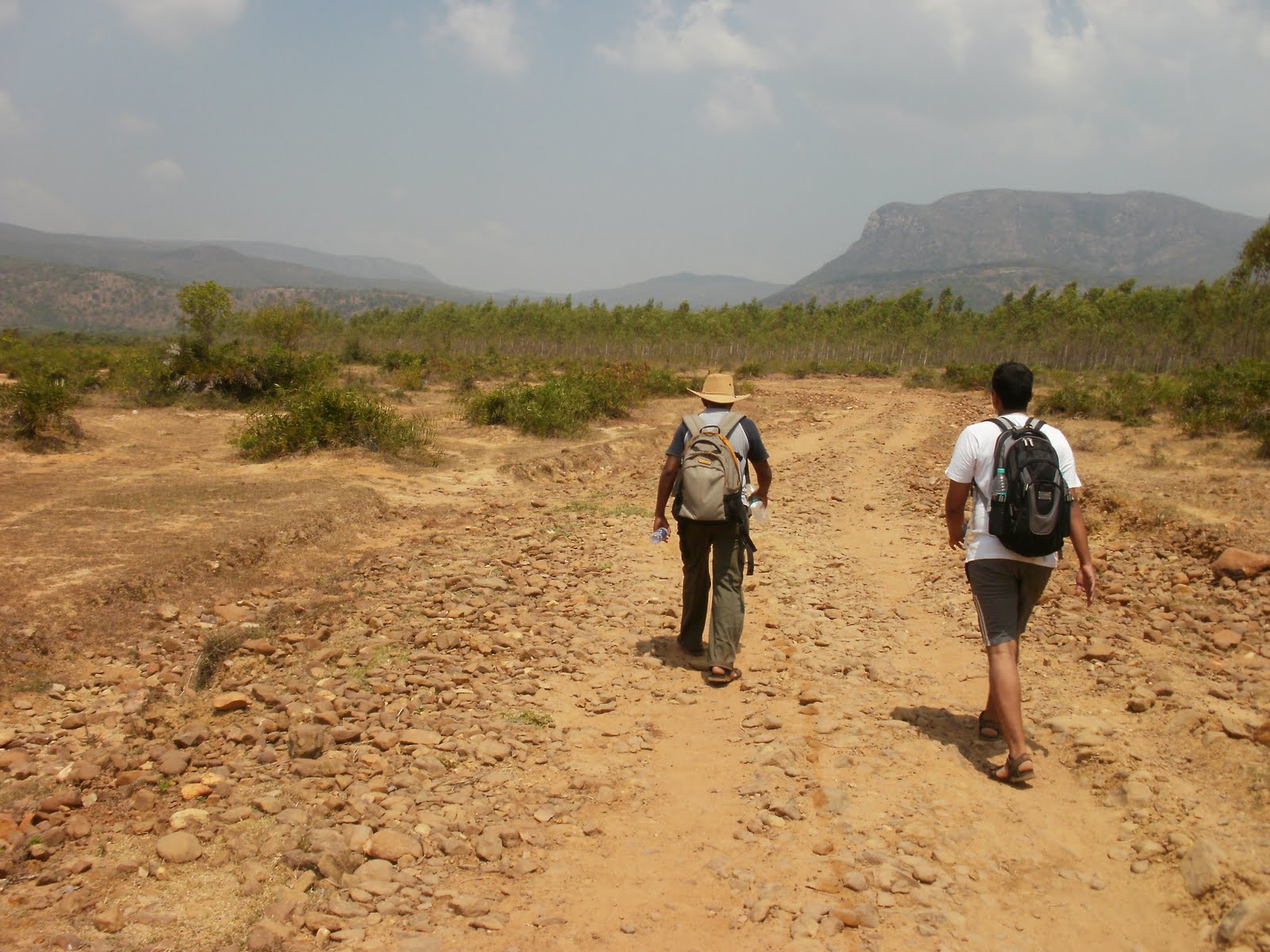
Trek to Nagalapuram - Nature at its pristine best

(I write this article both to describe the beauty of the place and also to help people who may wish to travel to this place.)

Chennai is, by far, the worst city that I have lived in or visited. The weather is bad throughout the year, the city is congested, travelling is a nightmare and there are hardly any places of worth visiting in or around the city. But in this huge pile of coal as well, there are a few well hidden diamonds. And thankfully they are well hidden. Else they will be molested before one can say plastic.

One such diamond are the hills near Nagalapuram. Technically in Andhra Pradesh, though it is only a couple of hours from Chennai. On friday, Narayan (Maya) suggested why don't we go for a trek tomorrow. Abhilash and me were like yeah! cool. We shall. A blog, of someone who had gone on a trek along with the Chennai trekking Club suggested we try Nagalapuram, and on Saturday off we were.

We took the Sapthagiri Express from Central at 6.30 a.m and reached Puttur at 8.30. From puttur, Nagalapuram is a 20 minute bus ride. At Nagalapuram there were share autos ready to con us. We one of those to T.P Kotah. At T.P.Kotah a small mud road will branch out and take you an extremeley small village. The mud path is around 3 kms.

(Rs.15/- per person is a fair fare. The auto fellow may haggle to take the mud road, but force him to anyway. If you drive by car reach this village and park. Also the auto fellow may ask you if you want toddy. We passed. But if anyone wants toddy auto fellow is the man to approach)

After this we began the actual trek. Initially we walked on a path riddled with pebbles and stones. There were a few farms on one side of this path and a neat wood/ orchard on the other. We walked along under the blazing sun and extreme heat. This was the most irritating part of the whole experience. Extremely tiring and barren.


After walking for about 3 kms we saw a small small temple that was just constructed and then reached a dam. We crossed the dam at the wrong end and had to cross a marshy stream to reach the correct side.

(It was fun, but I would suggest using the conventional route anyway. When you reach the top of the dam move left and climb down at the edge of the reservoir. Do not move right here)

Once the dam was crossed and we reached the correct side of the bog we reached a temple. This was the last bit of civilisation that we saw. If we had crossed the dam on the correct side we would have reached this place directly.

From here, we entered the forest. The forest was pretty dense but there was what could be described as a small path that we could follow. This path, I assume, would be a stream when it rains.

The forest felt air conditioned after walking for 6 kms in the sun.(Though i ask you to haggle with the auto driver to reach the small village, we didn't). We, being absolute amateurs, carried only 1 litre of water for each of us. We were running out of water when we reached a beautiful rivulet which had the clearest water I have seen and the nicest I have tasted.

Reaching this river, felt like reaching heaven, and we had not seen anything yet. We rested under a tree for some time and started again. We did not know how to proceed. So, we decided we will follow some footsteps that we could see on the sand. These people seemed to have crossed the stream and gone on the other side. We crossed and soon reached a place where 5 paths met. Again we thought we will follow the people who went before us. We walked for about fifteen minutes and realised that the people must before us must have been as lost as we were. So we decided we will return to the 5 way junction and move along the stream. We reached the junction and began moving along the stram but the path progressively became narrower and we thought we were sure to get lost if proceeded. And since, by now we realised the other dudes were as lost as we were, we thought lets go back to the rivulet, and move ahead on the other side itself. If we reach nowhere we can simply relax by the rivulet and then return.

So we return to the rivulet, sit down by the tree again and start cursing, if the Chennai Trekking Club knew about this place, couldn't they provide rough directions. An arrow mark with charcoal or chalk or something. After a while we get up up, and what do you know, right on the rock we were sitting there was an arrow pointing the way forward :)

So we start moving along on the path, which meandered along the same direction as the stream. The stream at places would broaden and form what can be termed as small pools. In most cases at the neck of these pools would be a small waterfall, about three or four feet high. At one such pool, we stopped and ate lunch, which was apples, bananas and grapes.

We saw four such pools. The fourth one was a small pool but had the tallest cascade. This one was about 10 feet high. Water was trickling down mildly. We climbed to the top of the falls and reached what can only be described as the best bathroom in the world. The stream was flowing at about ankle height and there were three or four natural formations in the shape of a tub where one could lie down and relax with your eyes closed as water flows over you. When you open your eyes it will seem extraordinarily surreal as all you can see is the sky and the tops of the hills. (I can to a great extent now appreciate what Elije Bailey went through in the bathroom on Aurora). It was for me, the most refreshing bath ever.

(The next image is of me taking a bath. So for the squeamish, the prude, and those by principle do not approve of upper body nudity, close this page. Those who like watching photographs of man enjoying nature scroll down)


We just didn't feel like leaving that place. It was mid - afternoon and we were out in the sun, but we couldn't get ourselves to move.

Finally we decided we should start moving else returning home would be a huge problem.(Our rookiness further exposed by the fact that we did not even carry a torch). The return was a blur. We did not get lost anywhere and were soon at the small village. Luckily for us a share auto had come there on another trip, and dropped us at Nagalapuram. We were too late to reach Puttur and catch the return train to Chennai (Leaves Puttur at 6.20), so we used state transport buses and reached Koyambedu.

The experience was awesome and I definitely plan to return there atleast once more before leaving Chennai for good. I hope this diamond never gets stolen. It deserves it privacy, and deserves to remain hidden from prying eyes.

This is one post I would love if extremely few people manage to read!

Monday, February 22, 2010

Is All Well

I am rarely ever pissed out or disillusioned by the system. I believe members of the system sort things out pretty well and by the end of it imbibe what is necessary and important. Smart people get noticed no matter what. And the not so smart find their niche. At least eventually. But last week I was left sightly perturbed. And this was because the system was changing for the better.

Though it sounds ironic it is completely true. Two incidents occured which were the cause of the disturbance. And both were related to the fact that though the policy makers were trying to push the system towards the better, either due to inertia or incompetence the system was resisting this change.

First incident happened in Pune. I was visiting my cousin's family, which consists of him, his parents, his wife and 2 kids. My nephew, who studies in senior kindergarten, is an extremely smart and talented chap. I was playing with him in the garden and while playing he started singing All is well from 3 Idiots. He sang it till the third paragraph without missing a single word and from what i can understand of music, in tune.

At school he was being taught the spellings of the days of the week using some new high funda system called phonics. Essentially they are taught to spell according to sound of the words. Great! But the concern came from when my sister-in-law started her daily teaching/ homework routine.

Point 1: I thought CBSE banned homework for anyone below class 5. I raised my eyebrow but didn't say anything.


So they start their routine. She asks him the spelling of Tuesday. And he starts T - E _. Before he says anything more my S-I-L asks him is it T-E. He thinks and says T-E and before anyone can react dude gets one tight one on the back and is told its tuesday. So obviously its T-U-E-S-D-A-Y. Dude gets this into his head, and when asked again says T-U-E-S-D-A-Y and writes it down three or four times. Then they go to some other stuff. Just to test him she asks him spell tuesday. And what do you know, dude goes T-E and get another tight one. I see this get pissed and say please don't hit the child. And she snaps back, Well, don't teach me how to teach my children!

I leave the room and say nothing else.

Point 2: In my opinion T-e-u-s-d-a-y sounds as the correct spelling to my phoneticaly challenged brain. And in either case i wouldn't give a fig if I were in senior kindergarten.

My sister-in-law in general is a very nice person. Extremely friendly. She is amongst the people i am closest to , in spite of the fact that I must have interacted with her at any considerable length maybe 10 times in the last 7 years. But she wants to push her child to succeed.

So once she is done with her son she comes over to me and starts a discussion telling me why she thinks she is right. She tells me what I absolutely abhor is a child making a mistake because of his carelessness. He knows the right spelling but is saying the wrong stuff only because he is careless. I tell that is exactly my point. You know he is smart. You know he gets what he is being told. So one day he will know the spelling of tuesday. He will learn all he needs to anyway. So why push him in a brutal manner.

She retorts saying, what you say may seem nice in Utopia, but not in India. If someone wants to shine he cannot afford to be careless. Careless today, careless forever. I was like you are missing the point. A 5 year old kid is expected to be careless. Hell, when the system is trying to change for the better (I mention point 1), when the system is trying to move towards Utopia, why don't we let it move.

She put in a rider as well saying do not tell me not to hit him when he is present. He might lose discipline. I was like you are making the case weaker for you, aren't you. Anyway she continued with her arguments (stuff like when he has the memory to remember songs so well why not spelling) and me offering the usual counters (so you want him to mug stuff. And isn't it a great thing he can remember the songs in the first pace. After reaching heaven why do you wish to be God as well).

Finally I was like we hold completely opposite view on this. And both of us are stubborn. It would be completely pointless to take this argument further. I see you yourself think my system would be utopia and shift to this. Till then you can have your system, I will keep hope for mine.

After this I reach Mumbai. Another nephew (7 standard dude.) comes home and says he has an assignment and needs to download some pictures and stick them onto his book. I am like, Cool! using technology to understand stuff better.

But I think I had the thought a little to early. He opens his book and opened wikipedia. Fair enough. So his assignment was to get examples of various sub classes of chordata and further the subclasses within mamallia. Stil fair enough. So I assume he will enter the class in wikipedia and see what he gets and proceed. But instead he sees some vague example his teacher gave him, downloads and saves. I tell him why don't you search some more. See what wikipedia tells you. I mean you are using technology might as well use it well. He was like you don't know my teacher. I try acting smart, she wont understand. She won't even know or appreciate. So this is better. I insist he search more. So when we get to the sub-classes of mammals he somewhat relents. Searches a bit and uses unique examples. He used a capybara, which are apparently the biggest rodents, instead of the usual rats or squirrels. I was supervising till then. I leave the room, and when i get back he has downloaded giant panda for carnivora. I tell him dude are you sure the giant panda is carnivorous. It after all eats only bamboo and see your teacher has not mentioned it either. He thought about it for a moment, bulbed, thought about his teacher and was about to remove it from his examples when wiki saved him with the fact that the panda are almost completely vegetarian carnivores.

So he continued. For Primates I told him to use my pic. I said I am human enough. He said no, I have already risked being failed by my teacher. I will not do that. I will prefer an Orangutan. I tell fail for what? For learning great stuff?:

At this my brother enters and says don't bug the poor fellow. His teacher surely will not what a capybara is, and won't even care that the giant panda is a carnivore. So just let him be.

I let him be, but felt bad for my cousin and his ilk. Though they are encouraged to use the comp so that they can show off with fancy print outs they are absolutely discouraged from thinking originally. They were using technology worse than the way we were using books.

Surely blaming the system in this case is unfair. Therefore I would prefer it go back to old rigid version. In that case at least the system would have been a nice fall guy. Now all we can do is feel bad that inspite of having so many factors pushing us ahead we are trying to waste away and actually move backward!!!

Friday, January 15, 2010

The Devil of Brat's Hill

Three little bed-bugs decided to go on a trek
and to their delight noticed Brat's Hill 15 Degrees South by Southwest
In their excitement to conquer the hill they created quite a mess
And woke the notorious devil who till then peacefully slept.

Now,the devil though dangerous, was extremely clumsy
More so when he was tired and sleepy
He tried swatting the bugs but ended up hitting the hill
Creating caves as though bored with a drill

The three bed bugs marketed the caves as a tourist spot
And this brought more bugs - a dozen every lot.
They said," In addition to being a place of great leisure
Missing the devil's hits by a whisker is an amazing sport of adventure."

This the devil took to his heart And vowed to destroy bugs near and far
He prayed to the ghosts of pest control who sent in ammo by the hordes.
The devil fired indiscriminately and destroyed bugs and eggs
And leaving their homes a complete wreck

Sunday, August 30, 2009

Music gives you wings

Last night, was randomly surfing channels when the I reached a channel playing Vennilave, from Minsara Kanavu. The tune is a well known intoxicant, and as it played through I got a kick I am sure even people addicted to potent drugs don't.

It had all symptoms. My mind felt relaxed. I was smiling for no particular reason. Other people speaking made no sense. The mind was completely immersed into the song. The next song that played was average, and i switched off the TV halfway through that song. The next dose in other words, had to be at least equally potent, if not more so.

Being addicted to Rahman's music is something great and I really do not mind being a peddler of this drug.

Sunday, July 26, 2009

My biggest regret!!!

I have been thinking about it and have found my biggest regret to date. NO! Its not the fact that I haven't netted a girl in four years of college. Neither is it that I did not get a PhD admit. Its not even something like not being able to find a place in the Indian cricket team.

Its something far more substantial, and something I had full control of. Not having failed a single exam in my entire academic career till date. Forget an exam, I haven't even failed in an unit test.

I came mighty close on two occasions, but yet failed to fail. One was a unit test in electronics in my 11th standard. That was the only time my bad handwriting helped me pass. No one, not even the teachers knew the answers to the questions set. For most people in my class, who had good handwritings, the teachers would have felt extremely guilty to give marks to something obviously wrong. But in my case they wouldn't have been able to decipher what I had written, and would have come to the conclusion that there is a possibility that he has written some sense, so lets just ignore and give him pass marks. I got something like 22/50 and thus passed.

The second instance was in college. Bioprocess II. Here I had hardly any clue on what was happening, and the professor did. And very technically I failed the assessments. But this was in our 6th semester, the semester after which we are placed. The professor turned out to be a good guy, who didn't want an arrear to mar our chances to get a job. So he gave us a second chance. For all the people who failed in the internal assements, including me, he put the internal assessment score as 25/50 and thus essentially making us pass out assessments at least. So on record I still passed.

Well anyway I am mostly done with exams in the school or college sense, and will have to carry this regret with me till the end. Even if I do have to take such exams, looking at my record I hardly doubt that I will pass each of those.

The only silver lining in this dark cloud of regret is that I have never managed to cross 90% marks overall in any exam ever. I have been a consistent Mr. 80 - 90 %. And that speaks decently of my consistency!

Thursday, July 16, 2009

Free Advise... Freely Given

It is so irritating. I am slowly becoming the old thatha that everyone fears. I hate people advising me, and I rarely if at all take up that advise. Unless that was the route i would have taken anyway. And similarly unless asked I would never give any suggestions. And even then only say what I did in a similar situation.

But when you are jobless and have nothing to do, you end up offering advise, that probably has no use to the person, but who listens to you anyway, as they have no other option.

I really hope that this does not get extrapolated and when I am really a thatha I don't pick random people and start off, "You have taken Biotechnoplogy, start searching for projectys and aim to do a phd. Its very easy to get through, I wqas a weird case. GRE is not important and you can score well anyway."

Oh! Hell! The thought is scary!

Wednesday, July 8, 2009

Maksat

I got thinking. What are my options ahead? And I came to the conclusion that there aren't too many. Its pretty irritating to realise for sure, that what Naseeruddin Shah says in Iqbal is true. "ज्यादा तर लोग, अपनी पूरी ज़िन्दगी बीता देते हैं यह जाने बगैर कि उनके जीने का मक्सत क्या हैं!"


Option 1: You have come so far and it hasn't hurt you yet. So makes sense to continue research.
Pro: Its a double positive. You'll have two careers. A researcher and a teacher. The odds favour liking both options and in any case definitely the latter.The second option being something that has always seemed like a calling. I have been doing it in one way or the other since the 9th standard. And it is I must say attractive. The changes of getting a position as a research scholar are also extremely good. No immediate financial liability either.
Con: In case it messes up you cannot even say the money is good and that is why I am in it.


Option 2: Get into the career of selling stuff or selling and buying companies selling stuff or a part thereof. Do an MBA.
Pro: Money will not be the issue ever.
Con: I really do not think I'll like selling stuff.

Option 3: Thanks to the education system and also honestly a natural disposition, the mind fits into the bureaucracy. So work for the government.
Pro: Odds favour job satisfaction being good.
Con: Too many people think the same way. The competition will be killing and the subjects that I have had to pass to become a B.Tech will not help me write the civil services exam. So getting the job will be almost impossible.

All other options are not pragmatic to consider at this juncture. Maybe a day will come when I am forced to consider them.

Till now option one and probably teaching seem to be जीने का मक्सत। 100 % conviction is still not there, but I must admit it is the closest to that figure that I have got to in memory. Even more convincing than, probably the feeling as a 7 or 8 year old that my ideal career would be an rail engine driver. The only issue is that though I know getting in would be a pain, option 3 still tugs a bit at the heart strings.